
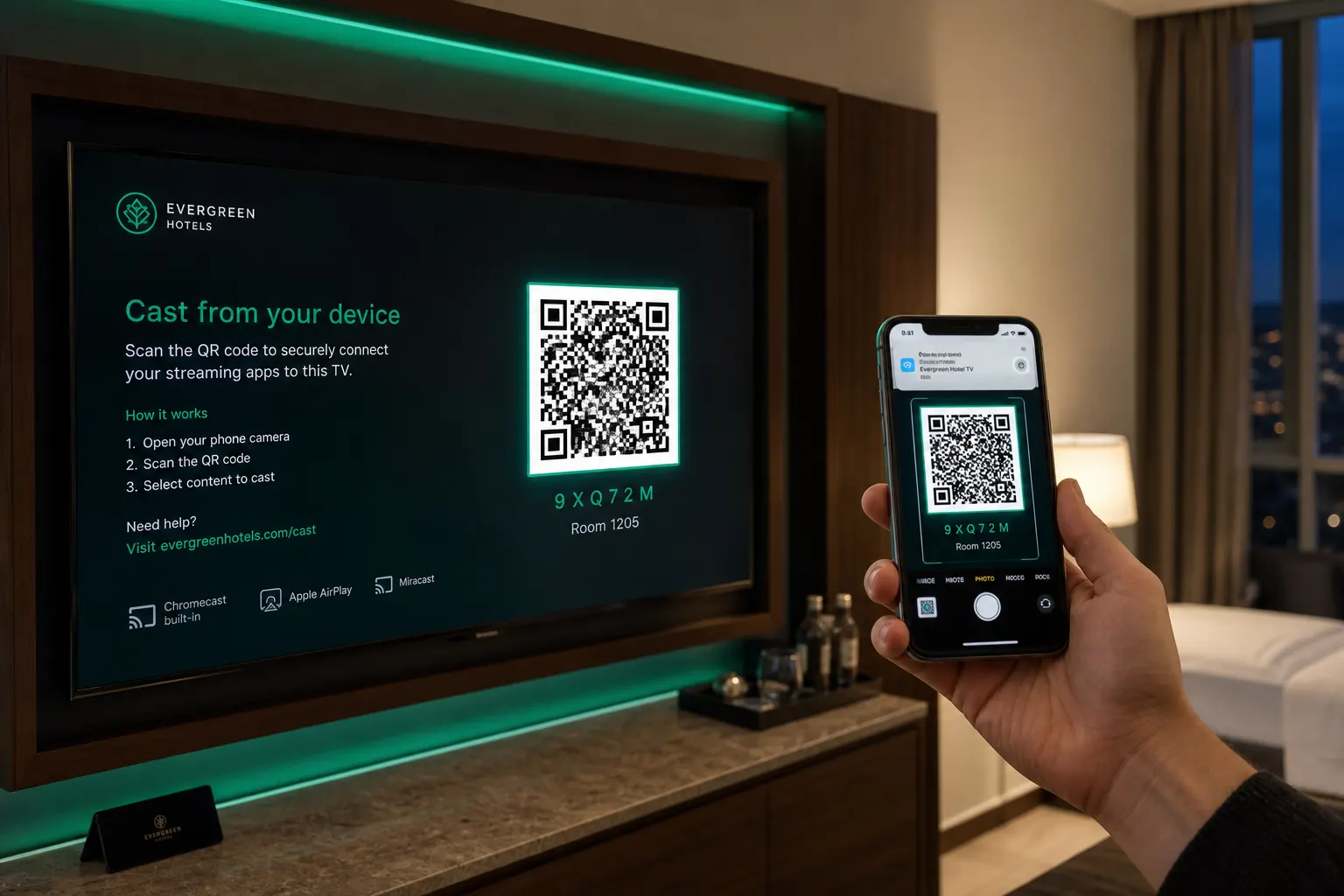
Why consumer casting breaks in a hotel
Chromecast was designed for a home: one flat network, a handful of trusted devices, and discovery by mDNS broadcast. Every device on the network can see every casting target, and that is a feature at home. In a 200-room hotel it means a guest opening the cast menu sees a list of two hundred televisions.
The consequences are not theoretical.
- A guest casts to the wrong room by accident, interrupting another guest.
- A guest casts to another room deliberately, which is harassment the hotel is responsible for.
- A previous guest's streaming account stays signed in on the device after checkout, exposing their credentials and viewing history to the next occupant.
- Guest devices become mutually visible, which turns the guest Wi-Fi into an attack surface between unrelated guests.
- Cast sessions persist after checkout, so a departed guest can keep controlling a screen in a room they no longer occupy.
Per-room isolation, and the problem it creates
The correct network design isolates each room so devices in room 412 cannot reach devices in room 618. This is usually achieved with per-room VLANs or equivalent client isolation on the wireless infrastructure. It solves the security problem cleanly.
It also breaks casting, because mDNS discovery does not cross subnet boundaries. The guest phone and the room TV can no longer find each other. This is the exact point at which many hotels give up and flatten the network again — trading security for convenience.
The three ways this is solved
1. An mDNS gateway or proxy
A service that relays discovery messages between subnets, but only between a specific guest device and the casting target assigned to that guest's room. Isolation stays intact; discovery works. This requires network infrastructure that supports the relay and a controller that knows the room-to-device mapping.
2. QR or PIN pairing
The TV displays a code. The guest scans or enters it, and the system binds that guest device to that specific room for the duration of the stay. This is the most robust approach, because the binding is explicit rather than inferred from network topology, and it works even when a guest is on cellular data or a VPN. It also gives you a clean audit trail of which device was paired to which room and when.
3. Screen mirroring instead of casting
Some platforms mirror the guest screen rather than handing off a stream. It avoids the discovery problem entirely but generally delivers lower quality, drains the guest battery, and is blocked by DRM on most commercial streaming apps — which is usually the exact content the guest wanted to watch. Treat it as a fallback, not a primary design.
Checkout teardown is not optional
The single most important control is what happens when the guest leaves. On the checkout event from the PMS, the system must, without human intervention:
- 1Terminate any active casting session immediately.
- 2Unpair every device bound to that room.
- 3Sign out of all streaming applications on the casting device.
- 4Clear cached credentials, tokens, and viewing history.
- 5Reset the device to its clean default state and return the TV to the welcome screen.
If any step depends on housekeeping remembering to do something, it will eventually not happen. Automate all five and tie them to the PMS checkout event, then test the whole sequence as part of commissioning rather than assuming the vendor did it.
What to specify in a tender
If you are putting guest casting out to tender, these requirements separate a serious proposal from a box-shifting one.
- Each guest device may discover and control only the casting target in its assigned room.
- Pairing is explicit — QR or PIN — and survives the guest switching between hotel Wi-Fi and cellular.
- Per-room network isolation is maintained; the solution must not require a flat guest network.
- All sessions, credentials, and history are destroyed automatically on the PMS checkout event.
- Casting works alongside the IPTV channel lineup on the same screen, with a clear way back to live TV.
- The system reports, per room, whether the casting device is online and healthy.
- Guest bandwidth is managed so that casting in one room cannot degrade service in another.
Bandwidth, briefly
Casting pulls content from the internet, not from your headend, so it consumes guest internet bandwidth. A hundred rooms streaming 4K simultaneously is a genuine capacity question, and it is one worth answering before go-live rather than during a full house. Per-room rate limiting and a realistic view of peak concurrency belong in the network design, not in an incident report.