
The five things that actually move the number
Ignore the feature lists for a moment. A hotel IPTV quote is mostly determined by five variables, and if you can answer these before you talk to a vendor, you will get a far more accurate proposal — and a much faster one.
1. Room count and room categories
Per-room cost falls as room count rises, because the headend and middleware are largely fixed costs spread across more keys. A 300-room property pays meaningfully less per room than a 50-room property for the same platform. Room categories matter separately: if suites need a different welcome screen, a wider channel package, or a larger VOD catalogue than standard rooms, that is configuration work and sometimes additional licensing.
2. Whether your TVs are already hospitality-grade
This is the single biggest swing factor, and it is frequently the reason two quotes for the same hotel differ by a large multiple. Hospitality TVs from LG, Samsung, and Philips can run the IPTV client natively via their built-in platforms, which removes the set-top box entirely. Consumer TVs generally cannot, so every room needs an STB plus power and mounting.
- Existing hospitality TVs with a supported native platform — lowest cost, no per-room box.
- Consumer TVs in good condition — add a set-top box per room; the TV stays.
- Mixed estate across floors or wings — expect a hybrid design and a slightly higher integration effort.
- End-of-life TVs — TV replacement will dominate the budget and should be quoted as a separate line.
3. The state of your cabling and network
IPTV runs over IP, which means it runs over your network. Older UAE properties were often cabled for coaxial SMATV distribution only, with no structured cabling to the guest room. There are three realistic paths, in ascending order of cost and disruption.
| Scenario | Typical approach | Cost and disruption |
|---|---|---|
| Cat6 already in every room | Use existing structured cabling; verify switch capacity and PoE budget | Lowest — often just switch upgrades |
| Coax only, no data to rooms | IP over coax (MoCA or Ethernet-over-coax) reusing the existing runs | Moderate — avoids opening walls and ceilings |
| No usable cabling | New structured cabling to each room | Highest — civil work, ceiling access, room downtime |
A vendor who quotes without surveying your risers and comms rooms is guessing. That guess becomes a variation order later, which is where hotel technology projects usually go over budget.
4. Licence model — perpetual versus subscription
This determines whether your cost is CAPEX or OPEX, and it changes the five-year total significantly. A perpetual per-room licence is paid once at deployment, with an annual maintenance contract afterwards. A subscription model spreads cost as a recurring per-room, per-month fee.
Neither is universally better. Owner-operated properties with a capital budget often prefer perpetual. Management companies working to an operating budget, or properties expecting a refurbishment within a few years, often prefer subscription. What matters is that you compare quotes over the same time horizon — five years is a fair benchmark — rather than comparing a one-off figure against a monthly one.
5. Integrations
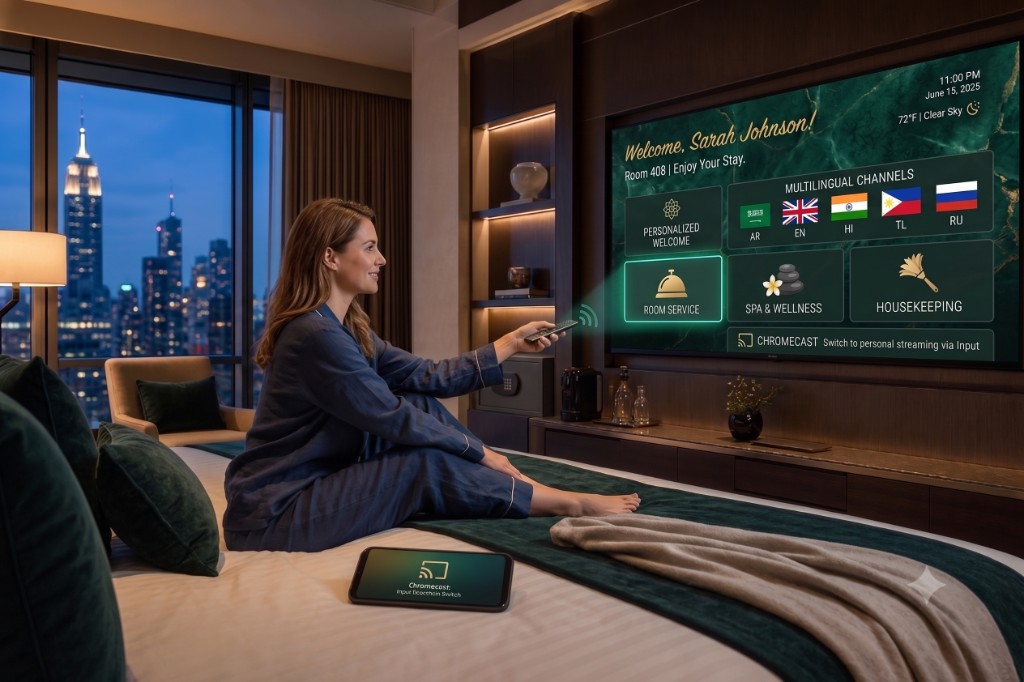
PMS integration is the most common add-on: guest name on the welcome screen, express checkout, folio viewing, and automatic room reset at checkout. Some PMS vendors charge their own interface licence fee on top of what your IPTV vendor charges, and that fee is billed to you, not to the integrator. Confirm it early.
- PMS interface — Opera, Protel, and similar; check whether the PMS vendor bills a separate interface licence.
- Chromecast or guest casting — usually a per-room add-on with its own network requirements.
- Digital signage for lobby and F&B — often shares the same CMS, which reduces cost versus a separate platform.
- Emergency broadcast override — priority messaging to every screen; sometimes bundled, sometimes not.
The line items vendors leave out
When you compare proposals, the cheapest one is often cheapest because something is missing. These are the omissions we see most often in UAE tenders.
- 1Content and channel rights. The platform is not the content. Confirm who holds the licences for the channel package and whether that cost is inside or outside the quote.
- 2Annual maintenance contract. A system with no AMC is a system with no guaranteed response time. Check what the AMC covers in year two onward, not just the free first year.
- 3Spares holding. Ask how many spare STBs and TVs are held locally and who pays for them.
- 4Staff training and handover documentation. If nobody at the property can add a channel or change a welcome screen, you will pay the vendor for every small change.
- 5Site attendance during commissioning. Night work and phased floor handovers cost more than a single continuous installation window.
- 6Removal and disposal of the old system.
What to send a vendor to get an accurate quote fast
You can compress a two-week quoting cycle into a couple of days by sending this upfront.
- Total key count, broken down by room category.
- TV make, model, and approximate age — a photo of the label on the back of one TV per category is enough.
- Whether rooms have a data outlet, and what is in the floor comms rooms.
- Your PMS name and version.
- Number of public-area screens and where they are.
- Target go-live date, and whether the property stays open during works.
A note on the cheapest quote
Hotel IPTV is not a product you buy once. It is a system that has to survive daily guest use, staff turnover, firmware updates, and a channel lineup that changes. The vendor with the lowest number is sometimes the right choice. But if that vendor has no local engineering presence, the real cost surfaces the first time a floor goes dark on a Friday night during a full house.