
The core difference in one paragraph
SMATV — Satellite Master Antenna Television — takes satellite and terrestrial feeds at a central dish, processes them into a single distribution, and pushes them over coaxial cable to every TV in the building. Every room receives the same broadcast at the same time, and the TV tunes to it. IPTV converts those same feeds into IP streams delivered over your data network, so each room requests its own stream independently. That single architectural difference — shared broadcast versus individual stream — explains almost every other distinction between them.
Side by side
| SMATV | IPTV | |
|---|---|---|
| Cabling | Coaxial, usually already installed | Structured data cabling, or IP over existing coax |
| Upfront cost | Lower | Higher |
| Per-room hardware | None beyond the TV | Set-top box, unless the TV runs a supported native client |
| Channel lineup changes | Headend work, affects all rooms equally | Configuration change, can differ per room category |
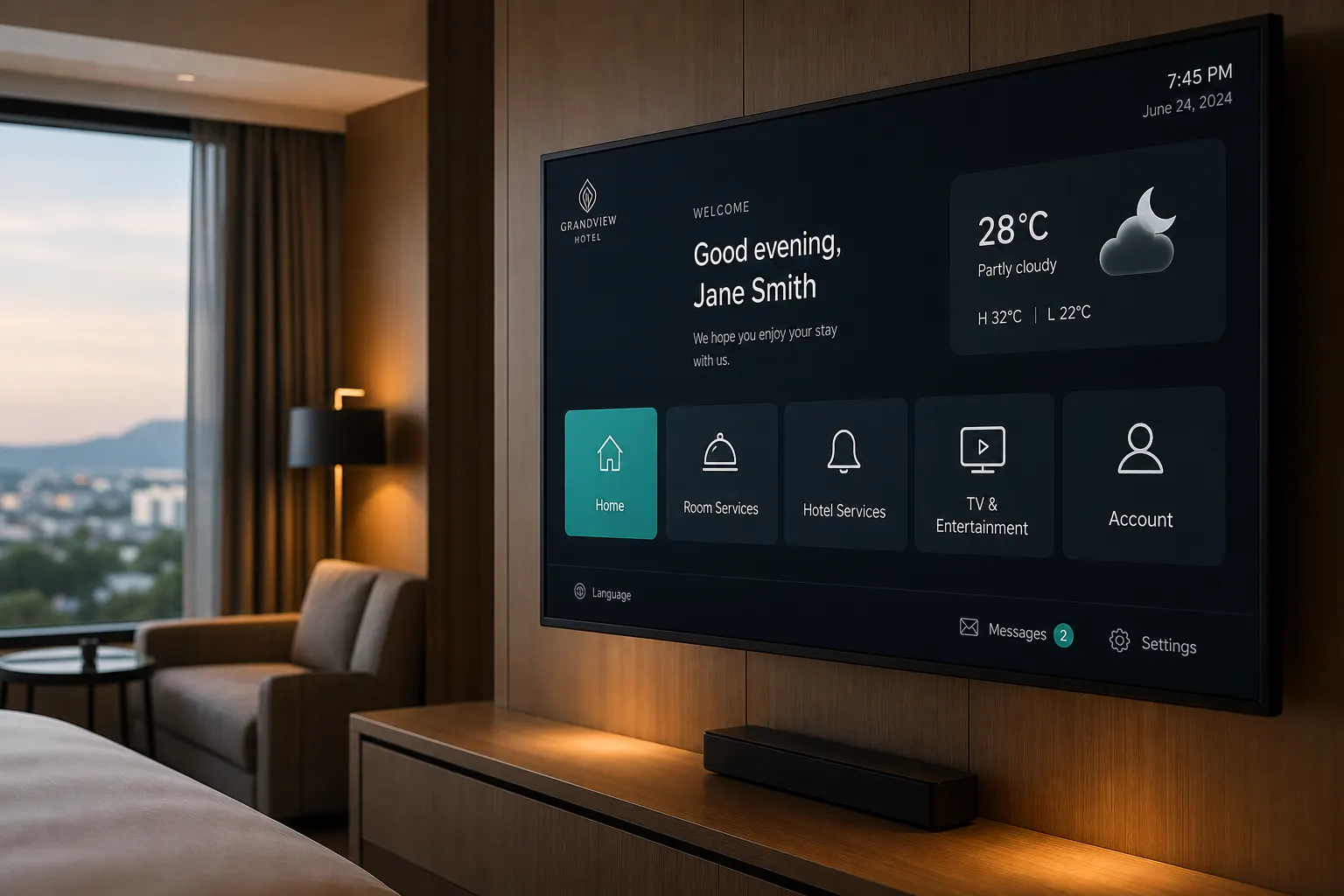
| Guest name / welcome screen | Not possible | Standard |
| PMS integration | Not possible | Standard |
| Video on demand | Not possible | Supported |
| Emergency broadcast override | Limited | Targeted, per floor or property-wide |
| Fault visibility | Reported by guests or found on a floor walk | Remote monitoring shows which rooms are offline |
| Ongoing cost | Low | Licensing and AMC |
When SMATV is still the right answer
We have talked properties out of IPTV. It is the correct recommendation in these situations.
- Budget and economy properties where the guest expectation is simply "the TV works and has the channels I know."
- Properties with a confirmed refurbishment or rebrand within the next 18 to 24 months — spend the money once, after the refurb.
- Buildings where no data cabling exists, IP over coax is not viable after survey, and the recabling cost cannot be justified by the room rate.
- Staff accommodation and back-of-house areas where interactive features have no commercial value.
When IPTV pays for itself
The business case for IPTV is rarely about picture quality. It is about the things that only become possible once each room is addressable individually.
- Upselling. Room service menus, spa slots, late checkout, and F&B promotions on the welcome screen reach every guest without printed collateral.
- Operational cost. Express checkout on the TV reduces front desk queuing; remote monitoring removes the daily floor walk to find dead TVs.
- Brand standards. International operators increasingly specify interactive guest TV, multilingual interfaces, and guest-name personalisation as part of the brand manual.
- Segmented experiences. Suites, club floors, and long-stay rooms can each get a different channel package and landing screen without touching hardware.
- Safety. A genuine emergency override that interrupts every screen — including the ones currently switched off — is difficult to achieve over SMATV.
Hybrid: the option most vendors skip
It is entirely reasonable to run both. A common pattern in UAE properties is IPTV in the guest rooms and public areas where the interactive value is real, with the existing SMATV distribution retained for back-of-house, staff accommodation, and any wing awaiting refurbishment. This spreads capital cost across budget years and avoids stranding the investment already made in coax.
A hybrid also gives you a fallback. If the IP path fails during commissioning, the coax distribution is still physically present, which materially de-risks a phased cutover in an open, operating hotel.
Upgrading from SMATV to IPTV without closing the hotel
The concern we hear most often is disruption. In practice the headend and middleware work happens in the comms rooms with no guest impact at all. Room-level work is what needs planning.
- 1Survey the risers, comms rooms, and a sample room from each category before anything is ordered.
- 2Build and commission the headend and middleware in parallel with the existing SMATV system still live.
- 3Convert one floor as a pilot and run it for a week under real guest load.
- 4Roll out floor by floor, working with housekeeping around occupancy, typically converting rooms during the standard cleaning window.
- 5Decommission the SMATV distribution only after the final floor has been stable for an agreed period — or keep it for back-of-house.
A property that stays open throughout can be converted this way. What determines the schedule is room access and occupancy, not the technology.