
Start with who is actually watching
The defining characteristic of worker accommodation in the UAE is linguistic diversity within a single facility. A typical camp may house residents whose primary languages include Hindi, Urdu, Malayalam, Tamil, Telugu, Bengali, Nepali, Tagalog, Sinhala, and Arabic. A channel package assembled for a hotel guest profile serves almost none of them.
This is the first question to answer, and it is an HR question rather than a technical one. Get the actual language breakdown of your resident population from your accommodation records before anyone designs a channel lineup. Then revisit it, because the mix changes as projects and workforces rotate.
Communal viewing changes the design
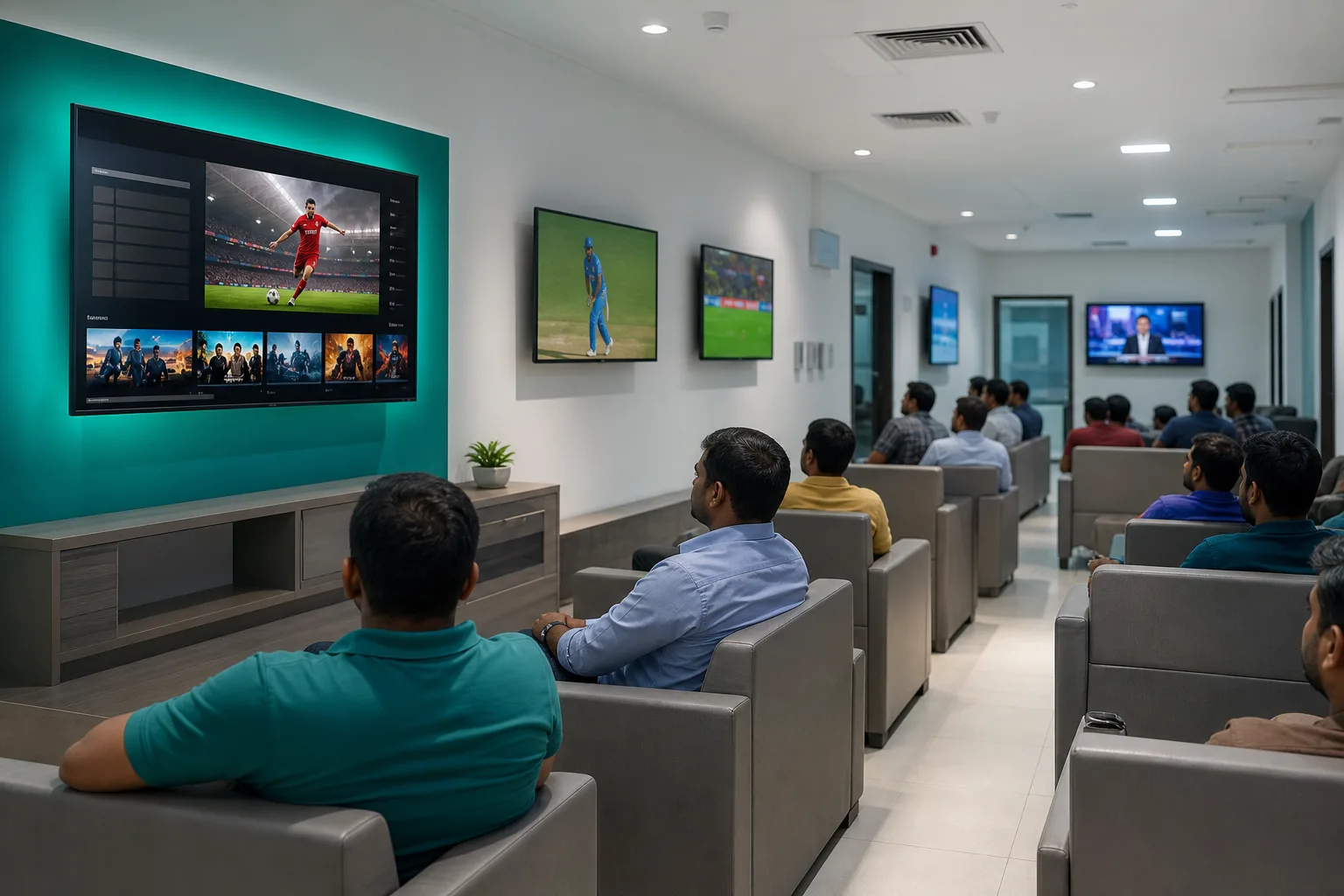
In a hotel, one guest controls one screen. In labour accommodation, screens are usually in shared recreation rooms, dining halls, and prayer areas, with many residents per screen. That single difference drives most of the design decisions.
- Channel control has to be managed. An unrestricted remote in a room of sixty people generates conflict. Common approaches are staff-controlled scheduling, a fixed lineup per room by language, or a request system through accommodation management.
- Multiple screens per room, each carrying a different language, work better than one screen everyone argues over — and are usually cheaper than the alternative in management overhead.
- Viewing peaks hard. Evenings after shift, days off, and major cricket or football fixtures concentrate demand in a way hotels never see.
- Volume management matters. Screens near sleeping areas need scheduled quiet hours enforced by the system rather than by a supervisor.
Hardware has to survive the environment
Equipment in shared accommodation runs longer hours, in dustier conditions, with more physical handling than the same equipment in a hotel room. Specifying hospitality hardware here is not over-engineering; it is the difference between a three-year asset and a nine-month one.
| Consideration | Why it matters here |
|---|---|
| Commercial-grade panels | Rated for extended daily operation; consumer TVs degrade quickly under 16-hour communal use |
| Secure wall mounting | Reduces accidental damage and theft; keeps screens out of reach in high-traffic areas |
| Locked-down settings | Prevents residents changing inputs or picture settings and generating support calls |
| Concealed cabling and STBs | Removes the most common physical failure point |
| Dust and heat tolerance | Comms rooms in camps are frequently not climate controlled to hotel standard |
| Local spares holding | A dead screen in a recreation room is a welfare issue, not a cosmetic one |
The operational case beyond entertainment
The reason to justify this spend is rarely entertainment alone. Once every communal space has a managed screen, the same infrastructure carries operational and safety communication that currently relies on notice boards and word of mouth.
- Safety announcements and toolbox talk reinforcement, displayed in the languages residents actually read.
- Emergency broadcast that overrides all content and reaches every communal space simultaneously — materially faster than a manual sweep.
- Transport schedules, shift rosters, and pay-cycle notices, updated centrally instead of reprinted.
- Induction and training content for new arrivals, delivered consistently.
- Camp rules, welfare contacts, and grievance procedures displayed permanently rather than posted once.
Operators subject to welfare inspections and client audits generally find that a managed, multilingual communication system in every communal area is straightforward to evidence and reflects well during those reviews.
Network and bandwidth realities
Camps are often on constrained connectivity — a single link serving thousands of residents, sometimes in a remote location. This shapes the architecture more than in any other vertical.
- 1Deliver live channels from a local headend over the internal network, so viewing does not consume the internet link at all.
- 2Use multicast for live channels. With unicast, every additional screen adds bandwidth linearly; with multicast it does not.
- 3Cache recorded and induction content locally rather than streaming it repeatedly from the cloud.
- 4Keep the management platform functional when the WAN is down, so a connectivity outage does not take the screens with it.
- 5Reserve internet capacity for resident Wi-Fi if you provide it — that is what residents will complain about first.
Getting a realistic quote
Vendors quoting camps from a hotel template will get the price wrong in both directions — over-specifying interactive features nobody will use, and under-specifying the durability and language coverage that actually determine whether the system survives. Send this with your enquiry.
- Resident capacity and current occupancy.
- Number of communal spaces and screens needed in each.
- Language breakdown of the resident population.
- Whether any structured cabling exists between blocks and to communal areas.
- Available internet capacity at the site.
- Whether you need emergency broadcast and operational messaging, or entertainment only.
- Who will operate the system day to day — your facility staff or a managed service.